
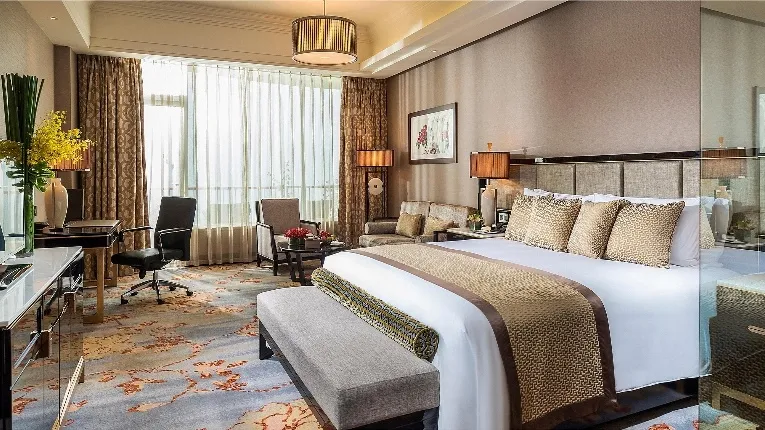
Custom hotel room furniture should include five working zones, not a random list of pieces: a sleep zone built around the bed and its base, a bedside zone where the guest's hand lands in the dark, a work-and-vanity zone dimensioned for a laptop and a chair, storage that opens without being unpacked, and a fixed shell of paneling, wardrobes and doors that holds the room together. When we audit a room that guests describe as "uncomfortable" without being able to say why, the cause is almost always one of those zones being dimensioned for appearance rather than for use.
This is the checklist we run with hotel owners and operators before a room package goes into production. It comes from building furniture for five-star properties since 1990, and from the maintenance calls that arrive two years after handover — which are, in practice, the most honest review a piece of hotel furniture will ever receive.
Start With the Room, Not the Furniture List
A furniture schedule tells you what to buy. It does not tell you whether the room will work. Before we quote a package, we map the guest's route through the room: where the suitcase lands, where the phone charger goes, how far the bed is from the bathroom door, whether the wardrobe can open while the bathroom door is open, and where a person actually stands when they take off their shoes.
Most comfort failures are circulation failures. A desk chair that cannot pull back because the bed is 600 mm away. A wardrobe door that hits the luggage bench. A nightstand on one side only, so the second guest has nowhere to put a glass of water. None of these are visible in a rendering, and all of them are decided at the drawing stage.
What Custom Hotel Room Furniture Should Include, Zone by Zone
| Zone | Pieces | Comfort detail worth specifying |
|---|---|---|
| Sleep | Bed, base, headboard | Finished bed height, base ventilation, headboard angle |
| Bedside | Nightstands, reading light, sockets | Top height against mattress, reach from pillow, cable routing |
| Work and vanity | Desk, chair, mirror, TV cabinet | Knee clearance, chair pull-back, mirror height for a standing adult |
| Storage | Wardrobe, luggage bench, drawers | Hanging height for long garments, bench height for a 28-inch case |
| Fixed shell | Wall paneling, doors, frames, skirtings | Acoustic backing, edge protection, repairability |
The sleep zone
Guests judge a bed in the first ten seconds, standing next to it, before they lie on it. That first impression is set by finished height, how far the mattress sits above the base, whether the duvet tucks without dragging, and whether the headboard gives something to lean against. A bedroom bed built for a hotel has to do three jobs at once: present well, support a mattress that housekeeping will rotate, and survive being moved for carpet cleaning.
The base matters more than buyers expect. A platform with no ventilation traps moisture under the mattress in a humid climate, and the first sign is a smell the room cannot lose. We build bases with ventilation and with removable panels so maintenance can reach the mechanism without dismantling the bed.
The bedside zone
The test is simple: lie on the bed, turn off the light, and reach for a glass of water and a phone without sitting up. If either hand has to search, the bedside tables and footstools are in the wrong place or the wrong height. Nightstand tops typically want to sit slightly above the mattress surface, deep enough for a lamp and a book, with the socket reachable from the pillow rather than behind the drawer.
The work and vanity zone
Business travelers forgive a small room but not a desk they cannot sit at. Knee clearance, a chair that pulls back far enough to stand up, and a light source that does not reflect on a laptop screen are the three specifications that decide whether the desk is used. The TV cabinet and dressing table set often doubles as the vanity, which means the mirror height has to work for a standing adult and the cable routing has to be planned before the paneling is fixed.
Storage and the luggage bench
A guest who lives out of a suitcase for three nights never fully unpacks. That makes the luggage bench one of the most used pieces in the room and one of the least specified. It needs to take a hard-shell case dropped from standing height, a wet coat, and a laptop bag, without the top veneer lifting at the edges. Inside the wardrobe, hanging height for long garments and a shelf a standing adult can see decide whether the storage is used or ignored.
The fixed shell
Bedroom casegoods get the attention, but the fixed furniture is what guests hear and touch constantly: the bed background, the wall paneling behind the desk, the wardrobe carcass, the door and its frame. Acoustic backing behind paneling reduces the sound of the corridor. A door frame that is solid enough not to move when the door is slammed protects the wall around it for a decade.
Comfort Is Mostly Dimension, Not Cushion
Hotels often try to solve comfort by adding softness: a thicker mattress topper, a deeper sofa, a plusher chair. In a commercial room, softness without support becomes a maintenance item within a year, because the filling compresses where guests sit and does not recover. What actually reads as comfort is the relationship between surfaces — seat height to table height, bed height to nightstand height, bench height to case size.
The dimensions we check on every room package
- Finished bed height against the mattress specification — decided together, not separately.
- Nightstand top against mattress top, and distance from the pillow edge.
- Desk knee clearance and chair pull-back distance from the nearest wall or bed.
- Luggage bench height against the largest case the hotel expects.
- Door and drawer swing against every other swing in the room.
The Details Guests Never Notice and Housekeeping Always Does
Comfort has a second half that guests experience indirectly: how the room holds up. A drawer that closes softly at handover and grinds six months later was built with the wrong runner for the load. A bench whose edge veneer lifts after a season was edged without a protective profile. A headboard that loosens from the wall was fixed into plasterboard instead of being tied back to structure.
When we review a design with a hotel's engineering team, we ask what the housekeeping routine looks like: which chemicals are used, whether furniture is moved for carpet cleaning, whether mattresses are rotated, how often rooms are deep-cleaned. Those answers change the specification more than any mood board. A finish that survives a gentle cleaner but not the hotel's actual protocol is the wrong finish, however good it looks on the sample board.
Why One Manufacturer for the Whole Room
When the bed comes from one factory, the casegoods from a second and the paneling from a third, three timber tones meet in a room lit by a single window. The mismatch is not a quality failure; it is a coordination failure, and it is almost impossible to correct after installation.
We manufacture both families in the same plant in Zhaoqing, Guangdong, China: movable pieces and fixed joinery, finished on the same line from the same veneer batch. That is also why a room package from us arrives with one set of touch-up materials and one maintenance instruction instead of three. Our production is certified to ISO 9001, ISO 14001 and OHSAS 18001, and our furniture has been installed in more than 500 high-star hotels, including properties operating under Ritz-Carlton, Conrad, InterContinental, W Hotels and Banyan Tree. A recent example of a full-room package is the Harbin Ritz-Carlton project.
Frequently Asked Questions
How many pieces should a standard king room include?
Most five-star king rooms carry a bed and base, two nightstands, a desk or vanity with a chair, a TV cabinet, a luggage bench, an armchair or ottoman, and the fixed items — headboard wall, wardrobe, door and frames. The exact list follows the room type and the brand standard, but every zone above should be represented.
Can you match an existing room when only part of the furniture is being replaced?
Usually, yes, if we can see a physical sample or a piece from the original batch. Timber and finish matching across production runs is the hard part, which is why we ask for a sample rather than a photograph. Where an exact match is not possible, we will say so before production rather than after delivery.
Do you supply the mattress and soft goods as well?
We manufacture the furniture. Mattresses, bedding and loose textiles are specified by the hotel or its supplier, and we dimension the bed base to the mattress specification the project provides so the finished height is correct.
What is the best time to bring the manufacturer into a room design?
Before the room layout is frozen. Comfort problems are simple to solve on paper and awkward to solve after the wall paneling is fixed. If the layout is already set, we will still review it and flag the constraints we can see.
Send us your room types and we will come back with a furniture list mapped to each zone, including the dimensions that decide comfort. Custom hotel room furniture is easier to get right when the checklist is agreed before anything is cut.
Request a Room-by-Room Checklist Browse Hotel Room Furniture